It’s been another full on week. I’m really not sure what I was thinking earlier this year when I agreed to a bunch of stuff for Aug-Oct. Yesterday, I hit Week 29 which means next week I’ll be into my last 10 weeks. True to everyone’s word, it’s gone both ridiculously quickly and agonisingly slowly. And it’s really starting to panic me how much I still have to get done before the baby arrives.
At Week 28, they do the glucose tolerance test and a bunch of blood tests – mainly for iron levels. Because of my blood type, I also had to get a shot of AntiD. AntiD is pretty short in supply so you have to book that ahead of time to make sure they have it available. I did all of these last Monday. I’d been having dizziness and funny turns during my pregnancy so I was a bit worried I was going to fail the glucose tolerance test. In the end, the entire thing was uneventful. Apart from the grossness of the liquid sugar, slightly fizzy drink, and the morning sickness due to fasting, I was just tired – too tired to do the work I’d brought for the two hour sit. They gave me the AntiD about an hour in to the stint. And took bloods at the beginning. The day after I found out I was pretty anemic and have gone on some extra iron. So far, I think I’m starting to feel a bit more energetic since taking it. And I’m hoping it will bring that spurt of energy before the much promised slide into the final weeks.
I’ve been relying on GTD to help me get organised, ready and start to get on top of things. In the last post-Galactic Suburbia recording chat, we were discussing those who like to do things down to the wire and under pressure of deadline (me) and other people, who do things ahead of time (you know who you are people who wrote your Lit essays the week you got the assignment). I was saying that I think I like doing things so close to deadline because it forces me to be succinct, and allows me to hand it in without having to give the work more thought. That if I did it ahead of time, it would mean I could and therefore *should* think over what I’d done, maybe tweak it, rework it etc. That done wouldn’t feel like “done” if I completed it a week or two before it was due. Course, there have been the odd times in my life where I’ve rethought what I wanted to hand in *after* I’d handed it in, and doing the work ahead of time would have enabled me to improve my response. But I guess that hasn’t happened all that many times in life to justify a change in habit.
Anyway, directly after that conversation, I had a really busy week. I’d completed my Weekly Review on the Monday, which involves scoping out up coming deadlines and what you need to do to manage them etc. In that week, I had a couple of days of solid doctor appointments (I try and book up whole days for this stuff as I have the two hour commute, may as well not do that too many times if I don’t have to.) and then a couple of days of things like presentations etc (the Romance Writers conference, a MasterClass at Curtin etc). As I did my plan for the week and worked out what I wanted to prepare for each of my commitments, I soon realised that to get something done that was needed on Thursday, I needed to do it Tuesday and could only do it Monday afternoon or Tuesday due to other commitments. And similarly for the weekend commitments, could only do them Tuesday or Friday. But if I did them Tuesday, I could spend Friday on PhD research which would otherwise fall by the wayside for the week due to everything else.
Armed with this knowledge, that is how I managed the week. And then the clouds parted, angles sang and I experience a revelation! When you do things earlier than 5 minutes before deadline, it’s completely possible to forget about them and let them be “done”. And to in fact feel good about the fact that you are prepared for the next thing in your schedule and thus be working on the thing ahead of that. It was … dare I say it? Fantastically liberating! I didn’t have to rush around, didn’t need to flail and panic, as per my usual way of coping. I calmly went about my business. Got enough sleep. Had things packed and ready to go for each of my commitments. Had everything I needed on me for each commitment when I got there. And I calmly moved through life. That’s what happens, apparently, when you work this way. And I have to say, I really really like it. It’s a very effective way of managing pregnancy brain which renders me useless sometimes. And I suspect, it could be very useful for someone working on little sleep and holding a screaming baby. And on the Friday, instead of feeling bad and anxious about the presentations and public speaking I had to do on the Saturday, I actually worked on PhD stuff calm in the knowledge that I was as prepared as I could be for the next day’s gigs.
So now I’m quite addicted to the Weekly Review.
Tags:
gtd
Pretty much every other day, I take a moment to check whether the other shoe is starting to drop. I really can’t believe how lucky I am to be being given the opportunity to not only work on Twelfth Planet Press all day every day but also to be expected to be exploring new ideas, try new initiatives and to study practices around me. That the point of this whole exercise is to learn things about publishing in a time of great flux in the industry, and to hopefully, take out the other end of this study, a more viable and tangible business. Seriously. How did I get here? (The answer is always: Helen). It’s seriously try that if you find something you truly love, you never have to work a day in your life.
And the other great thing is getting to talk a lot about it as I go along. Documenting it as I go so I can pull it together into some kind of exegesis at the end.
After spending last week immersed in talking and listening to other people talk about the industry, I’ve been mulling over our novella line. I love novellas – I love the format. I love the fact that they are meaty enough to really tell a deep, expansive story but aren’t as big a reading commitment as a novel. We’ve had a lot of critical success at Twelfth Planet Press with this format. There is no shortage of really great novellas being written. The problem has been that the format in print is just not a viable product. As of this date, the only one that’s ever broken even is Horn by Peter M Ball. At some point, I had to make the decision that I couldn’t keep buying and publishing novellas when they weren’t breaking even. As much as I love the form, and as much as I believe that indie press exists to publish and bring to the reader works that are outside of the scope of commercial publishers, I couldn’t justify the drain on the cash flow. Especially when eventually that comes at the expense of being able to afford other projects that might be more financially viable.
Last week I participated in a panel with Joel Naoum from Momentum discussing all things publishing for a postgrad MasterClass at Curtin. One of the points that struck me about what they are doing at Momentum, is being able to pursue projects that are not viable in print form by going solely digital. Without a doubt, with the democratising of publishing via self publishing and with the merging of big publishers, we have two new and very strong factors at play. The first is that there are more titles being published every year than the year before. And I don’t really see that changing in the near future. Readers are still reading but I suspect the readers for every title is probably less, as the readers spread across more and more titles. I believe this means that the potential to earn for a writer (and publisher) is going to be less per title. Similarly, as the big publishers merge and try to compete against Amazon, they are looking to concentrate on high performing bestsellers. And we’ve seen that result in the loss of the midlist for some time. This, I still think is good news for a publisher like TPP, but not for authors who are still capable of earning reasonably but that “reasonably” is being redefined. And this is where we are seeing a lot of changes in publishing business models as savvy midlisters experiment with new ways to make a career.
A third, and no less important, factor is distribution. Bookstores are closing. Book distributors are folding. And it’s getting harder and easier to get stocked in bookstores. I’m finding that TPP is being picked up by a lot more franchised outlets of the big bookstores in Oz but that’s happening as I work harder to do distribution myself ie dealing with each bookstore one by one. At the same time, I’m also finding other bookstores becoming less open to stocking indie press. Responses like we only stock books by publishers like [named big five publisher] are also coming in.
What’s going to happen to traditional publishing? We don’t know yet but if publishers want to still be around, we’re going to have to adapt and change our models. What used to be is no longer. And what worked before may not in the future. What is clear is that we need to be flexible and open to new things. As I posted the other day, it is really clear that the stigma of digital only publishing or digital first publishing has long been lost in the romance genre. A genre which is alive and kicking and very financially successful.
The sum of all these thoughts: I love novellas and I’ve been looking for a way to be able to publish them again. And I’m keen to experiment with publishing models to see what and how to be successful going forward. And so, finally we are open to novella submissions again! http://www.twelfthplanetpress.com/submissions And hopefully, I’ll be able to use this in my thesis somewhere  I do quite like the double credit points of working on my press AND my PhD at the same time!
Tags:
novellas,
phd,
submissions,
Twelfth Planet Press
Over the weekend I attended the Romance Writers of Australia annual conference which was held in Fremantle, WA this year and titled Riding the Waves. It was my first time at a non SF (and non science) conference and I have to say, my mind was totally blown. It was a completely new and entirely fantastic experience and I think I might be hooked (as I was promised by Peter Ball who also attended).
I’d had a few engagements prior to the weekend that were related to this event as Curtin organised an academic programme on the Friday, related to the conference, and Helen was here. I was part of a MasterClass for Curtin postgrads looking at publishing opportunities post submitting (that was weird, being probably the earliest on the PhD path in the room). We also went to Helen’s book launch for her new book, Beyond the Cyborg, which was a lot of fun. So by the time Saturday morning came around, I was really glad that my husband had kindly agreed to both wake me up in time to leave and to actually drive me to Freo for my 9am panel. I wouldn’t have got there otherwise. He also hunted around trying to get me something to be able to eat to stave off morning sickness, sadly to no avail. And I entered the conference.
First up. The conference swag bag. It rivalled the World Fantasy bag but even though it had maybe a third of the books, it beat the WFC one hands down by having a pen, a keep cup AND a BOX OF CHOCOLATES. Hey, I’m easily won over. This was a conference that had a lot of chocolate just lying around for you to snag. You gotta love that.
The programme was already running behind schedule when I headed in to the plenary session and I stood at the back to listen to most of the keynote speech by Julia Quinn. She spoke a lot about what it takes to be a writer and a lot about the journey of being a writer. She was funny and smart and a pleasure to listen to. But one thing in particular she said really stood out for me – “you will never hurt your career by helping another author”. She elaborated by saying you will never lose a sale by promoting someone else’s book. That the only way you can lose sales is through the quality of your own books. And it was the beginning of a bit of a revelation for me. Not the sentiment, but that someone said it out loud. That it’s not a zero sum game – readers will read your book and someone else’s. And reading someone else’s doesn’t mean they won’t read and like yours. Or better yet, someone else having success doesn’t preclude you from having your own success.
After the keynote, I realised the segment before our panel was to happen so I grabbed a seat – the room was set up like a big banquet hall, with large round tables rather than rows of chairs. It was the main session room and I think the only programming until break out sessions later on. So everyone at the conference was in this session. The segment that followed the keynote was a small presentation by two head honchos from Harlequin. I’m not sure I can even express what this experience was. They basically ran through all their imprints and lines and talked about upcoming initiatives at their publishing houses(s). Which sounds simple enough, like an advert. But the advert was to woo writers. It was about selling themselves as a market that *wanted* the writers in the room to want to be a part of them. And what was exceedingly clear was that they have a really clear and thorough understanding of their readership and how to sell their books to them. They understand the business and the market.
After this, I was on a panel discussing pathways to publishing, moderated by Alex Adsett. Because the session was running behind, our panel was cut short but we discussed the different expectations and processes for a range of presses on submissions and rights and so on. It was interesting to see how much more digital only publishing is accepted and being adopted in the romance genre.
We broke for morning tea then, which was fully catered. And I was able to appease my growing morning sickness. I also caught up with both Peter and Donna. Peter made a comment to me about how every writer knows what exact genre niche it is that they write in and for the rest of the day, I asked every person I met what it is that they write just to see. And every single writer I asked knew *exactly* what their niche is (like out of 27 or something different sub genres). It was deeply fascinating. Someone came up to me at morning tea to speak to me about TPP and a book they had and we had a nice chat. After that I headed into a breakout session.
I had intended to work or read in between my two commitments which were hours apart. I’m not one for attending panels and I’m a natural introvert. This would be the kind of thing I would do at a SF convention if none of my friends were there – I’d just take off to the cafe and have a coffee and work and be quite happy. Except at this conference that didn’t happen. Because people didn’t just walk past you and ignore you or look you up and down and judge you and walk on. They introduced themselves to you and started a conversation with you. And before you knew it, you’d met a new person. This, I discovered, is what it’s like to go to an actually friendly convention. And to be in an authentic safe space. Everyone there was there for the conference. They were dressed professionally. And they were there for the same, specific purpose, to network, to learn and to share what they knew.
I chose the “Buy This Book!” breakout session after morning tea. It was a workshop run by Abby Zidle, an editor at Simon and Schuster (NY). A writer from the audience was invited to present her novel as though she was an acquiring editor advocating the publisher buy the book. And the rest of the panel was made up of other members of the audience, each representing the different department heads that would sit in an acquisition meeting. And Abby, as the mock publisher, led the mock discussion that would happen in a press house meeting to consider whether or not they buy a manuscript. I learned a lot in this session, more than I expected to. I knew how this process works – that your editor has to convince all kinds of people that the book will sell, beyond just “but it’s a *really* good book”. What I really liked is the idea that almost noone other than the acquisition editor will have read the manuscript for a meeting like this. It’s both weird and obvious. I like the idea that all the way along the process of selling a manuscript to a book, you are constantly in discussion with people about how good it is where the person buying it will be buying it on the say so of the editor and then the bookseller. People hand over the cash, to produce the book, and then to buy it as a reader, without knowing how good the book actually is. There aren’t many other products out there that anyone buys without really knowing just exactly what it is. I guess movies are the same. I learned a lot of things in this session. Abby was very generous in sharing and explaining all sorts of aspects of publishing including print runs and profit margins and why publishers invest in what things and so on. I took a lot of notes. *I* took a lot of notes in a con panel.
Lunch happened after this session. Catered lunch. I headed over to the restaurant and grabbed some food and then was ushered over to the special seating area for the conference. I thought this was a bit odd. I got sent down to the end of a very long empty table and by the time I had put all my things down and sat, more writers had been similarly sent my way, had introduced themselves to me and we got involved in a long and fascinating conversation. I think I met more published novellists that day than I’ve met in my whole life. And most of them were multiple times published authors. We talked about feminism, we talked about the romance genre, its being snubbed by most on the outside, and on writing and so on.
The thing that really struck me being in and amongst the attendees at this conference was how savvy everyone was. Being able to write a novel and sell it seemed kind of a given – and I guess seeing as most of the people I met had successfully done that, perhaps it was? But that what they really knew was their business – they know what their audience wants and how to give it to them. And they know how (and want) to mentor upcoming writers so that they may know what their audience wants and how to give it to them. There was a genuine air of sharing – of knowledge and support and know how. That information and experience isn’t for guarding and protecting lest someone else also find out your secret to success but rather that by sharing and helping others to also be successful, everyone benefits by greater success. Rather than spending time fighting and competing with each other, and tearing each other down so noone really achieves greatness due to being so busy fighting and fending off (jealous) attacks, they spend the time teaching each other how to be great. Kind of sounds like a utopia doesn’t it? When I asked a few people about it – that there didn’t seem to be much ego or pissing contests going on in the room – they said that there was a little of it here and there if you scraped beneath the surface but that no, by and large, it wasn’t really that kind of scene.
I met many women, of different ages and walks of life, who totally got what I’m doing at TPP, what the point of my thesis was and a bunch of other things that are true in my world, like getting ready for a baby and balancing career and motherhood etc. It seemed to me that romance is a genre that has been snubbed by the rest of the “literati” and it has sort of shrugged its shoulders, thought “well that’s your loss” and just moved on to do what it does – nurture writer and readers and sell a HECK of a lot of books. And, you know, make a lot of money. And not care what anyone else thinks about what it’s doing. It reminds me a lot of when I talk about sexism with women who’ve been fighting and around the issue for a lot longer than me and tend to just say – yeah, I just don’t listen to that shit anymore and don’t hang out with people like that, it’s not a fight I’m gonna win and I’m done wasting my energy and time on it. It always seems so relaxing and liberating, really.
After lunch I headed to a craft panel with one of the writers I’d had lunch with and brushed up on all things writing dialogue. Then I headed off to my pitch session. It was the first one I’ve ever done in person and I was really nervous about it. How would I facilitate nervous people through 8 minutes of them trying to sell their manuscript to me? I prepped myself a bunch of questions as prompts and met a lot of really enthusiastic people. It was pretty nerve wracking but I guess enjoyable. I asked to see some manuscripts and I’m interested to see what comes in. I finished off with a lovely debrief with Alex and Peter before my husband came back to pick me up.
And, I have to say, SF, we’re doing it wrong. There was so much about how this conference was organised, including the emails that came out before the event (which had information for people who had never attended before on what to expect and how they could fill the time so as not to feel nervous or anxious), that it was advertised as a perfume free event ahead of time was of interest to me (both because it was considerate of others but also, the opposite of the ones I’m used to which need to remind people to shower!). But also, I am so interested in the active community building that was on display and evident by the friendships and by the friendliness. Other people’s success was not sneered at or envied, it was applauded and encouraged. After all, when everyone else looks at you as a group to sneer at, you don’t really need to spend time and energy doing that inside the group, do you? SF has much to learn from this genre – they are on the cutting edge of the digital revolution, they know how to market and sell their work, they know how to take a one book deal into a long spanning career. And I can’t help but think it has a lot to do with the positivity and encouragement within the community.
I took a lot away from this conference. And I also want to be part of this community. I’m considering joining the RWA and going to next year’s conference in Sydney. I think there is a lot more I can learn about the publishing business here. And I really really liked the people I met.
Tags: romance writers conference 2013
 I am really liking my design wall. My charm quilt is almost finished – all the hexagons have been pieced together and now I am sewing the final panels together. I almost think I might miss all those teeny tiny triangles, now that I’m done.
All the while I’ve been working on this quilt, I’ve been looking forward to pulling it down and using the design wall to get a good look at my WiPs. And today was finally the day. I’ve only just begun pulling out everything from my craft cupboard and all the other nooks and crannies I’ve been stashing projects in progress. It would appear that either my design wall is not big enough, or I might have too many projects. My husband and I disagree about which it is
As I was pinning up projects, I began to see the real benefit of a permanent design wall. I liked it for the charm quilt to be able to piece it and then rearrange and try out different layouts til I was happy with the overall look. The same will be for each of the quilts shown here but I also like it for being able to find all the bits and pieces of partially cut out and sewn blocks and keeping them in a place where they don’t get lost. It reinforced my long held desire to have my own studio. I really really want a proper workspace where you can keep things up and together and not spread all over the house.
I think one of the reasons why I am so bad at finishing projects is because I lose where I’m up to and it feels too difficult to sit back down and re-figure it out. That was partly why I was excited about bringing my craft into my GTD system. In theory, that shouldn’t happen anymore. And I can see that using a design wall for projects in progress will also help that. And I think both will help me keep my momentum and interest alive enough to focus on finishing projects before moving on. It will be interesting to see whether my overall WiP project count changes over time. I’m thinking of tracking that
Currently up on the design wall are 7 quilts. Though the cameo with log cabins (lower right hand corner) was actually going to be 1 of 3 and probably now just needs to be quilted and bound. I also found 1 additonal finished quilt top and another that I’m going to completely pull apart and redo cause I hate it. And I still haven’t finished auditing my craft room yet. (Let’s not even discuss the knitting WiPs!)
I think another reason why I am so bad at finishing projects is because I fear not having anything left to do. I fear final completion. When dissected, it’s really quite ridiculous. Firstly, actually using all your stash and doing all your queued projects gives you permission to buy or start new ones. And WiPs are a debt on future time. Claustrophobic if I think about it too hard. Secondly, my actual list of dream / intended projects is going to be, when I sit down and make it, based on my current stashing alone, already probably another decade’s worth of work. Thirdly, the problem with finishing quilt tops is the having to buy wadding and backing which is expensive and then having to quilt them. I do hate the additional expense that finish garners. And also, I have come to admit, that I don’t actually like quilting. Not by hand anyway. And right now, I don’t have a sewing machine so I don’t have the option to do it that way. I’ve decided to pay someone else to quilt my quilts. And that’s also going to be something I have to balance against the fact that we have a baby coming and I have become a full time student. But … otherwise, what exactly is it that I am doing here? I might have to save up to get them quilted slowly over time. But at least now I have a plan and a way forward, so that feels good.
Next up, after auditing just what exactly all my craft projects are is to make a next actions list. Stay tuned for more finish-it-up-itis around these parts.
Tags: crafting, gtd, quilting
 I’m unlearning everything I thought I knew.
I guess somewhere along the line I joined the cult of David Allen’s GTD. And it involves rolling out management systems to increase your productivity across all of your life. The goal is to have a mind like water and in order to do that, you need to feel like you’re on top of all aspects of your life – all the projects you’re working on, the ones you want to be working on at some point in the future and be able to take a step back and see it all at a glance whilst also being able to view your life’s goals and dreams all in the one go.
It’s taken me a while to get all those systems into place but I can see how once they are, and reassessed regularly, how your mind gets calmer and you feel less stressed. Even though, you don’t have any less work to do or are any less busy. You just get to stop thinking thoughts over again, having to remember things or having to figure out what you have to do when or what your priorities are.
One of the techniques I’ve used in the past to remind myself of things I have to do or to get myself to do things is to leave them out in front of my face – piles of paperwork on my desk when I really prefer clear desks, things out on countertops and tables, craft projects in progress out on chairs and by my bed and all over the place. My thinking was if I put them away, I’ll forget that I was working on them. Or because I prefer clear, clutter free space, I’ll work on or do whatever is in the way so as to get the reward of clear spaces. Thing is? Your mind desensitises itself to the clutter so you get numb to it. But only numb enough so that you don’t notice it at a glance but not so numb that it doesn’t create background white noise stress.
It never occurred to me that there could be another way of keeping track of what I wanted to get done. Or that living in organised, clear spaces would energise and motivate me. I thought that was the goal rather than the means to the end.
Allen says that everything should have a place and that everything should be in its place. And the process of working towards that requires an assessment of just what exactly each and every “everything” is and a decision about what should happen to it – does it need something done? What’s the next action required for it to be done? Do you need it? Is it to be filed? Trashed? Does it need to be found a place. And then you put the next action on your list of actions and you put it somewhere, maybe away, cause you already have a stake in the ground so you no longer need the item itself to trigger a reminder for you. You have a system now.
I always thought that order and organisation and systems ruined/prevented creativity. I’m not really sure why I thought that. Considering I actually really love to feel organised and I thrive better on routine, or rather am a person of habit (just usually bad habits). I suppose I thought that my natural tendency is to want to *create* order through *doing* and that if there was already order, I wouldn’t be motivated to *do*. It never occurred to me that order and feeling organised and on top of things would actually energise and motivate.
It turns out, it feels fantastic to be able to put things out of way and know they aren’t out of sight and won’t be forgotten. A huge relief. A massive weight gone. And I can’t describe how it feels to start to see my house begin to look how I always imagined a grown up person’s house to look.
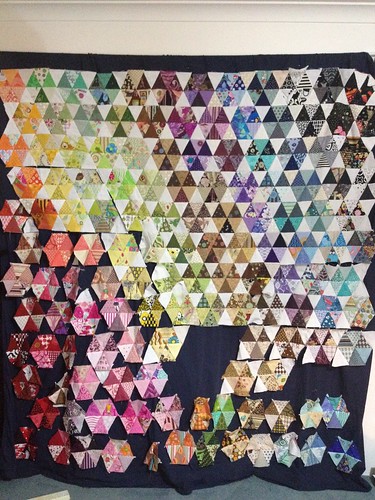
And the bit about creativity? I don’t think my brain has been so clear and able to work, effectively and productively, in a very very long time. I find myself writing paragraphs for my PhD randomly and with ease. And I’ve been working solidly on the quilt in the picture here.
In May, I took apart the whole quilt top that I’d assembled on this project so far as well as well as all the rest of the hexagons I’d pieced (which was enough for the rest of the quilt top, except I hadn’t decided that yet). It took me nearly a week to unpick all the hand sewing which I’d done over the course of maybe two years. And then I picked a new pattern. The original pattern, you see, didn’t work out – I had wanted to work with more colour play – light, dark and mediums to create a sense of shadows and movement. Except, I’d pieced the hexagons with related materials rather than in true charm square style – randomly – and it just didn’t work. I decided to abandon the original plan and just go with something else.
I pieced all the new hexagons first because I knew that what I needed to do was lay them all out and work out how I wanted to piece them together for the quilt top, rather than do it ad hoc as I went along. As I normally would have done, eager to see “progress” as I worked. But I stuck with it and I really did piece all the hexagons first. And then I got my husband to help me rig up a design wall. My very first design wall. And I’m addicted to it now! The freedom it’s given me to be creative has been amazing. I threw all the hexagons up, in a rainbowish layout. And then I spent a few days rearranging them all til I got the quilt to look balanced. I’ve never done that before. I’ve never worked on the overview as well as the fine scale at the same time, knowing where I was going as I was going. I thought working like that, on craft, would reduce the feeling of creativity – the knowing how it was going to look by the end at the very beginning. I thought it would take all the fun out of it. But actually, it’s given me focus and direction because at each step, I’ve known what the next action was. There’s no need for procrastination because I don’t need to think or improvise what happens next. I don’t need to put it away for a year to think about how I’m going to make it work.
And before the end of August, I’m going to have finished this quilt top. I’ve never worked on a project this way before. I’ve never finished a project this quickly before. And I ended up with colour play in the end after all. Adding the white triangles to create a star around each hexagon has added a sense of movement. The rainbow (a layout I have formally always detested as I felt it was pedestrian) actually gives the unmatched pieces a sense of uniformity and pattern. And the dark and light layout for each hexagon actually gives some shadow affects too.
The process has been really enlightening. Both for how I will approach crafting going forwards but also for much bigger life projects.
And normally, I panic when I am so focussed on one craft because I feel like it means I’m never going to be obsessed with the other one again. My old knitting versus quilting war. And I have a lot of knitting WIP projects there to be done. And also a lot of quilting ones. But now I have a “Craft Projects I Want to Make” list. Which I am still building. And now I have a management system that I am looking forward to trying out, once I’ve finished the Charm Quilt, to see if it will ease my distress over choosing my craft obsession We shall see! I suspect there will be some serious finishitupitis going on around these parts in the next few months.
Tags:
craft,
gtd,
life management,
quilting
 Entries